

IUMA researcher wins Fulbright scholarship to advance AI in space
Samuel Torres Fau, researcher at IUMA's Integrated Systems Division (DSI) and doctoral student in the Telecommunications Technologies and Computer Engineering programme under the supervision of Roberto Sarmiento, has been awarded a Fulbright scholarship for a research stay at the University of California, Santa Cruz (UCSC).
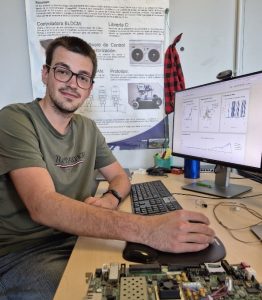 His thesis focuses on the development, compression and deployment of neural networks in hardware qualified for space use, with a special emphasis on Spiking Neural Networks (SNNs) and simplified recurrent networks. The work is being carried out in collaboration with Thales Alenia Space (Tres Cantos, Community of Madrid), with which a four-year project (2025–2028) has been signed.
Samuel completed a Master's Degree in Applied Electronics and Telecommunications (META) at IUMA, having previously obtained a Bachelor's Degree in Computer Engineering from the University of Zaragoza. During his master's degree, he joined the research line ‘Hardware/software systems for embedded electronics in satellites’, participating in projects related to digital design for space applications, including "European Robotic Orbital Support Services In-Orbit Demonstration" (EROSS IOD, HORIZON-CL4-2022-SPACE-01-11) and "Efficient Video Compression for Space" (ESA AO/1-1-10954/21/NL/MGu). In addition, it has developed the first VHDL version of the CCSDS 124.0-B-1 standard ("Robust compression of fixed-length housekeeping data”).
His doctoral thesis, entitled ‘Development of a working environment to accelerate the deployment of AI applications in space,’ addresses how to accelerate the use of AI in space missions, where hardware and consumption constraints mean that solutions used on Earth cannot be directly extrapolated. This research has led him to study and develop neuromorphic computing (Spiking Neural Networks, SNNs) and simplified recurrent networks (Minimal Gated Recurrent Unit, minGRU).
The Fulbright scholarship will fund a six-month stay at the University of California, Santa Cruz (UCSC), under the tutelage of Professor Jason K. Eshraghian, professor in the Department of Electrical and Computer Engineering and director of the Neuromorphic Computing Group at UCSC, whose work lies at the intersection of neuroscience, deep learning, and circuit/VLSI design.
Eshraghian is a leading figure in the field of neuromorphic computing and SNN training. Over the past five years, he has been cited 4,400 times, and his 2023 article "Training spiking neural networks using lessons from deep learning"has been cited nearly 1,200 times. Among his best-known contributions is snnTorcha widely used Python library for modelling and training these networks. His research activity has been recognised with various awards, including Innovator of the Year 2024 at UCSC, the IEEE VLSI Systems Best Paper Award (2019) and the Proceedings of the IEEE Best Paper Award (2024) for a landmark paper on SNN training. He recently launched the NeuroDump series with a first chapter entitled"LLMs Don’t Need More Parameters. They Need Loops” (https://www.youtube.com/watch?v=pDsTcrRVNc0), which has garnered 133,000 views in two weeks.
With this residency, Samuel will strengthen IUMA's line of research into efficient and robust AI for space environments, expanding it through international collaboration and access to cutting-edge methodologies in neuromorphic computing and brain-inspired learning.